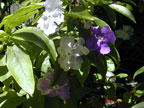
Brunfelsia australis (B. latifolia, B. bonodora)
morning, noon and night; Brazilian raintree
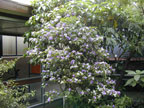
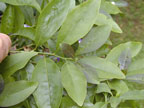
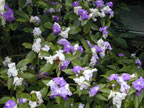
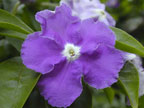
Garden shrub about 2m high with showy, fragrant flowers (30 - 40mm across). The flowers open bright blue / purple, but quickly fade to white. Leaves oval, 35 - 90mm long.
There are 12 species described, it is not clear how many are present in NZ. B. paucifolia (bigger leaves and flowers) and B. brasiliensis (smaller flowers and leaves) are occasionaly seen.
Gardens, especially in the north, although B. paucifolia can be found as a casual from Waikato north. It is a plant of warm areas and is unlikely to be seen in the S. Island.
Possibly a solanine type alkaloid. The fruit are the part usually implicated in poisoning cases but all parts of the plant are poisonous.
Dogs have been poisoned in Auckland. In Australia, young dogs living in warm areas are the main species affected.
Reluctance to move, ataxia, tremors especially in the back legs salivation, vomiting, diarrhoea, frequent urination, follwed by collapse and convulsions (similar to strychnine extensor rigidity) and possibly death.
Access to the plant. Plant material in vomit or diarrhoea.
Distemper, strychnine or metaldehyde poisoning.
Control seizures and correct fluid balance. Gastric lavage then activated charcoal. A warm soapy water enema may be necessary.
Death can occur in 10 hours, but most cases treated properly recover in 2 - 3 days.
McBarron, EJ. Poisonous plants of western New South Wales. Dept. of Agriculture, New South Wales, Sydney, 1978
McBarron EJ, de Sarem W. Poisoning of dogs by the fruits of the garden shrub Brunfelsia bonodora. Aust Vet J 1975;51:280
Neilson J, Burren V. Intoxication of two dogs by fruits of Brunfelsia australis. Aust Vet J 1983;60:379–380
Banton MI, Jowett PLH, Renegar KR et al. Brunfelsia pauciflora (Yesterday, today, tomorrow) poisoning in a dog. Vet Hum toxicol 1989;31:496–497
Singh M, Cowan S and Child G. Brunfelsia spp (Yesterday, today, tomorrow) toxicity in four dogs. Aust Vet J 2008 86 (6) 214-218