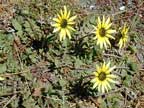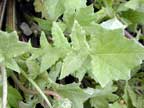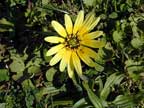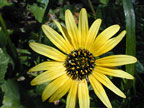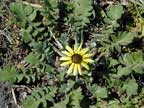
Cryptostemma calendula
Tufted biennial/perennial herb. Stems prostate or ascending. Leaves up to 20cm long divided pinnately, edges toothed with underside cottony white. Flowers have a purple inner surrounded by yellow and protrude on cottony pedicles.
Some garden daisies are similar but are unlikely to be seen in pasture.
Very common in northern North Island in waste places and pastures. Less common in bottom half of North Island, Cook Strait and northern part of South Island.
Capeweed is a nitrate accumulating species and thus causes a nitrate poisoning. The nitrate is converted to nitrite by microbes in the rumen. The nitrite binds to haemoglobin causing methaemoglobin to be formed which inhibits oxygen transport this leads to generalised tissue hypoxia. Hydroxylamine, one of the products of nitrate reduction can cause a severe haemolytic anaemia and haemoglobinuria in sheep.
Mainly ruminant poisonings recorded. Pregnant animals more susceptible and can abort.
Staggering, dyspnoea, cyanosis, rapid weak heart beat, ataxia which may lead to convulsions and death. Reported as causing a mild gastro enteritis and death in cattle and sheep.
Haemorrhages and congestion throughout. Blood dark red to coffee in colour.
History, clinical signs, leaves in rumen/stomach.
Methylene blue to reconvert methaemoglobin to haemoglobin. 1% solution at 1 - 2 mg/kg slowly iv.
Depends on amount eaten and time of treatment.
Do not allowed hungry livestock to graze areas where plants are growing.
Connor, HE, The Poisonous plants in New Zealand, 2nd ed.,1977, Government Publications Ltd., Wellington