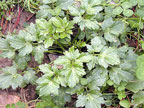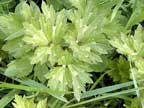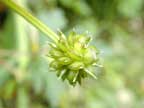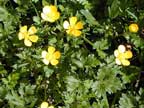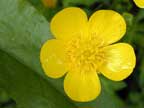
Ranunculus repens
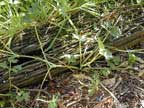
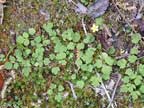
Hairy perennial plant with fibrous roots. Stems have stolons. Up to 70 cm tall with basal leaves on long petioles, of 3 lobes, the middle lobe stalked, which are also divided into 3. Upper leaves are sessile. (The shape of buttercup leaves varies accoding to where they are on the plant; the basal leaves are different from those on the flower stalk). Flowers upto 25 mm in diameter, yellow with 5 petals. Flowers are on furrowed, hairy stalks and sepals are hairy and not bent back.
Other buttercups (most are probably poisonous). Creeping buttercups can be differentiated by their stolons.
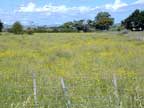
Plentiful throughout NZ. Prefers damp pastures and waste places but not fussy.
Ranunculin and the potential to be cyanogenic. All parts contain the glycoside ranunculin from which the irritant substance protoanemonin is formed by enzymic hydrolysis. Protoanemonin is unstable and polymerises to the inert crystalline and non toxic anemonin. Hence, hay made from buttercup containing pasture is safe when dried. The highest concentration of protoanemonin is found during flowering. Relatively large amounts of plant are required to result in toxicity. Creeping buttercup may contain less ranunculin than other species and it is not clear that it is clinically important as a poisonous plant.
Grazing animals. Animals tend not to eat buttercups in pasture, but where they are abundant as in areas such as Westland, Northland and other wetter western districts, they are invariably consumed by cattle in particular. Calves turned out for the first time are particularly vulnerable.
In most domestic animals (cattle in particular), poisoning produces an excessive flow of saliva, soreness (sometimes with ulceration) of the mouth, and abdominal pain. In severe cases, this is followed by diarrhoea, with the passage of black faeces, and blood stained urine. Animals will become weak and stagger and show impaired hearing and sight. Some animals will die and death is preceded by severe convulsions
Lesions of mild to severe gastroenteritis are usually seen in animals that die from buttercup poisoning. The rumen usually contains massive amounts of buttercup and mouth and throat lesions may be seen also.
History, clinical signs and evidence of ingestion.
Mild purgatives and demulcents may be give and potassium permanganate is said to be useful to protect the mouth and gut against the affects of protoanemonin. However, most mild cases do not need treatment.
Most mild cases recover spontaneously without treatment.
Connor, HE, The Poisonous plants in New Zealand, 2nd ed.,1977, Government Publications Ltd., Wellington
Parton K, Bruere A.N. and Chambers J.P. Veterinary Clinical Toxicology, 3rd ed. 2006. Veterinary Continuing Education Publication No. 249