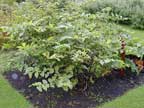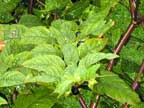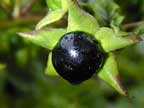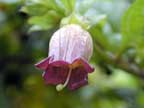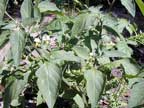
Atropa belladonna
Black nightshade is sometimes incorrectly called deadly nightshade.
0.5 1.5 m tall, glabrous or slightly pubescent herb with a perennial rootstock. Erect stems with spreading branches. Leaves are ovate, paired, always one large and one small together, laminae decurrent, short petioles, greyish green up to 15cm long. Flowers are pale purplish blue, nearly 3 cm long, solitary on short peduncles in the forks of the stem or leaf axils. Fruit is purplish black, glossy berry 10 15mm dia.
Other nightshades. Deadly nightshade is rare in NZ. It has a distinctive flower.
Introduced. Only found in Christchurch and parts of Northland. Usually grows in clear cut areas on fringes of bush, scrub or gardens. Prefers nutrient rich chalky or loam based soils.
A variety of antimuscarinic tropane alkaloids. Hyoscyamine (l atropine) is most abundant, followed by atropine and hyoscine.
All animals including humans. However companion animals including horses appear more prone to poisoning due to the habitat of the herb in this country.
Nausea, dilation of pupils, muscular weakness, stumbling and falling, frenzy and rarely coma. Large doses cause symptoms to appear more rapidly, vomiting and total blindness, complete incoordination of movement, painful respiration. Death results from asphyxia and heart failure. Mucous membranes are dry and the pulse is usually accelerated. A degree of generalised hyperaemia may be seen in the skin due to vasodilation of skin arterioles. This may also lead to a detectable drop in temperature. Bowel sounds will be reduced and a paralytic ileus may develop.
Post mortem changes are not well documented for any anticholinergic intoxication. Hyperaemia of skin may be seen in recently dead animals. Gut mucosal and serosal surfaces may appear pale.
History, clinical signs and contents of rumen on postmortem. No pupillary light reflex or accomodation reflex – Difficult to check.
Other Solanaceae plant poisonings. Iatrogenic antimuscarinic overdose.
Induce emesis, immediate gastric lavage with plenty of water and activated charcoal. Give diazepam or low dose barbiturates to reduce excitement. Physostigmine (anticholinesterase) iv rapidly negates the muscarinic effects. It also mitigates central clinical signs. The dose may need to be repeated after 30 60 minutes if negligible improvement is made. Do not use if animal is arrhythmic.
Good if diagnosed early and treated promptly. If dyspnoeic and cardioarrythmic; prognosis not good.
Avoid grazing hungry animals where large numbers of the plant are growing.
Cooper, MR (1998) Poisonous plants and fungi in Britain : animal and human poisoning. London : Stationery Office