Claviceps purpurea
main ergotism monograph
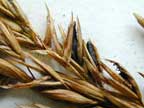
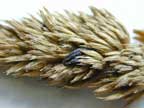
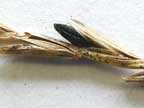
Ergot sclerotia (the resting phase between seasons, and the only visible part) is 10 - 35mm long, slender and curved, tapering to both ends, dark violet to black in colour, protrudes from the floret and occupy the position of seed of ryegrass or other grasses. Unpleasant odour with a sticky, honeydew phase.
Paspalum staggers is caused by another ergot, Cl. paspali. Ryegrass staggers and fesue toxicity are caused by other fungi which produce similar toxins.
Commonly on pasture grasses or grain crops throughout New Zealand.
Ergotamine, ergometrine etc. are primarily vasoconstrictive and result in gangrenous toxicity. They can be converted to LSD-type substances and therefore cause hallucination/convulsion. The disease results from the ingestion of several kilograms of contaminated seed heads over 2 - 6 days. Similar alkaloids are produced by other common fungi.
Cattle and sheep (sheep only experimentally as they tend not to graze coarse grass seedheads). All animals (including poultry and pigs) may be poisoned by feed made from infected grain people used to be poisoned by bread made from infected grain. Many modern cases in cattle are caused by infected silage.
Similar in all species, requiring several kg of seed heads containing sclerotia, consumed over 2 - 6 days for animals to become affected. Initially animals become nervous and hypersensitive. This is followed by tremors of the muscles of the limbs and body, seen particularly after exercise. This may become so severe that animals are unable to feed. There is marked incoordination of gait with swaying hindquarters, staggering and difficulty in posturing. Excess salivation and a rapid heart rate are also features.
Commonest form in NZ. Cattle: loss of weight, lameness, swelling, pain in one or more fetlocks, pyrexia; hooves, tips of ears and tail may show gangrene in severe cases. Hind limbs are affected first. Sheep: loss of condition, abortion, ulceration of oral mucosa, diarrhoea and convulsion.
Cattle: swelling, discolouration and gangrene of affected skin. If develops further there is sloughing of distal parts of limbs, ears or tail.
Sheep: Gastrointestinal ulceration.
Clinical signs, pasture analysis.
Encircling wire/rubber, foot rot or fescue lameness (Festuca arundinacea).
Move animals gently from infected paddocks and change to non toxic feed. Keep cattle warm underfoot. Apply warm, moist applications to limbs just starting to show signs of gangrene. Amputation if only one claw is affected.
Good especially if removed from toxic feed before gangrene develops. Poor if gangrene or sloughing of tissue has occurred.
Top pastures to prevent seed heads forming. Vaccines may be available in the future.
Connor, HE, The Poisonous plants in New Zealand, 2nd ed.,1977, Government Publications Ltd., Wellington
Cooper M R, Johnson A W. Poisonous Plants and Fungi in Britan: Animals and Human Poisoning. Her Majesty's Stationary Office. London. 1998
Hogg, R. A. Poisoning of cattle fed ergotised silage. Veterinary Record. 1991. 129: 313 314
Holliman, A. Gangrenous ergotism in a suckler herd. Veterinary Record. 1989. 124 398 399.
Parton K, Bruere A.N. and Chambers J.P. Veterinary Clinical Toxicology, 2nd ed. 2001. Veterinary Continuing Education Publication No. 208
Surveillance 2005, 32(3), 13