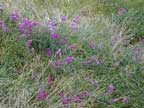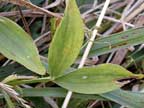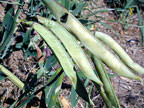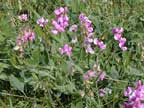
Lathyrus latifolius
Perennial pea. Often called sweet pea, but should not be confused with the true sweet pea, L. odoratus, which is only found in gardens (although probably toxic too).
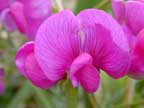
Scrambling perennial twining plant producing very showy pink or purple flowers. Blooms from late spring through late summer.
There are nine species of Lathyrus or vetchlings in NZ. All are probably poisonous.
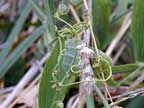
A relatively common plant seen throughout the country on waste ground. Prefers sunny areas and well drained soils - the photos were taken on a north facing railway embankment.
Seeds/peas contain the amino acid b (g L glutamyl) aminopropionitrile. This compound is converted after ingestion to b aminopropionitrile which causes the toxic effects.
Horses are particularly sensitive. Cattle, sheep, dogs.
Two forms are recognised:
May see skeletal deformities - reported in experimental animals.
A dissecting aneurysm of the aorta and a direct neurotoxic effect results in the degeneration of the spinal cord and nerves to the hind limbs.
Post mortem lesions, presence of plant in paddock and in the stomach, limb paralysis, painful gait (lameness) and roaring (in horses).
Colic (horses), osteoarthritis, copper deficiency (defective collagen formation), Lower motor neuron disease, aortic thrombosis (acute cases), strychnine, spinal trauma, cytotoxic oedema.
Essentially supportive therapies, if a large amount of seed has been ingested induce emesis where possible, and perform a gastric lavage. Dose with activated charcoal and a saline cathartic. Remove plant from paddocks.
Recovery can be complete, however some animals may be chronically affected. Death is possible in extreme acute cases.
Beasley V.R. (1993) A systems Approach to Small Animal Toxicology [vol 1 & 2]
Connor, HE, The Poisonous plants in New Zealand, 2nd ed.,1977, Government Publications Ltd., Wellington
Parton K, Bruere A.N. and Chambers J.P. Veterinary Clinical Toxicology, 3rd ed. 2006. Veterinary Continuing Education Publication No. 249