Pithomyces chartarum
main facial eczema monograph
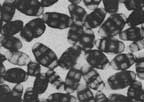
Minute black clusters of fungal spores, close to microscopic, found on newly dead herbage. Seen most commonly in spring and summer. Fungal spores look like hand grenades.
Lowland pastures in North Island and northern South Island. Lives in newly dead herbage, especially lightly grazed pastures. Fungus is dangerous when the temperature remains over 12˚C for 72 hours while relative humidity exceeds 98% (usually February and March). Animals are at most danger when grazing lowest stratum of pasture (ie. when densely stocked). Fungus is sparse and slow growing in the winter.
Sporidesmin; causes inflammation of bile duct epithelium. Leads to biliary occlusion, thus accumulation of bilirubin and phylloerythrin in the blood, which causes jaundice and photosensitization.
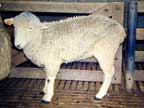
Sheep and cattle, small mammals (eg guinea pigs). Possibly grazing pigs.
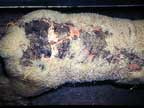
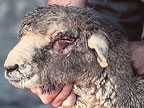
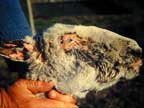
Photosensitisation - necrosis of unpigmented, unprotected skin exposed to sunlight (i.e. scabs around eyes, nostrils, ears and udder.) Signs of jaundice, such as yellowing of mucous membranes and sclera, weight loss, haemolytic crisis in severely affected cattle (with or without signs of photosensitization).
Yellowing of mucous membranes and sclera, liver damage (which may be seen as bile duct inflammation and occlusion, swelling, fatty infiltration, fibrosis, friability and typical boxing glove shape). Bladder mucosa shows ulcerative lesions.
Clinical signs and time of year. High concentration of bilirubin levels and phylloerythrin in the blood. High liver enzyme levels (GGT standard blood test used to evaluate the severity of liver injury).
Fasciolosis, St John's wort, ngaio, spring parsley, phenothiazine, doxycycline, alpha toxins, metal toxicities (phosphorus, copper) and other mycotoxins.
Symptomatic care. Protect from sunlight (dark shed/barn), shift to safe pasture or hay. Graze at night to avoid exposure to sunlight.
Poor; even if animals survive initial toxicity liver is irreversibly damaged and animals may compete poorly within the herd/flock.
Treat pasture with benzimidazole fungicide or zinc prophylactic treatment (spray pastures, zinc sulphate in water, zinc bolus administration to animals). Bear in mind that too much zinc is toxic too.
Connor, HE, The Poisonous plants in New Zealand, 2nd ed.,1977, Government Publications Ltd., Wellington
The Merck Veterinary Manual, edited by Susan E Aiello. Eighth edition published by Merck and Co. Inc, Whitehouse Station, USA, 1998.
Morris CA, Towers NR, Hohenboken WD, Maqbool N, Smith BL, Phua SH Inheritance of resistance to facial eczema: a review of research findings from sheep and cattle in New Zealand. New Zealand Veterinary Journal 52(5), 205-215, 2004
Munday R, Thompson AM, Fowke EA, Wesselink C, Smith BL, Towers NR, O'Donnell K, McDonald RM, Stirnemann M, Ford AJ A zinc-containing intraruminal device for facial eczema control in lambs. New Zealand Veterinary Journal 45(3), 93-98, 1997
Parton K, Bruere A.N. and Chambers J.P. Veterinary Clinical Toxicology, 3rd ed. 2006. Veterinary Continuing Education Publication No. 249
Smith BL, Towers NR. Mycotoxicoses of grazing animals in New Zealand New Zealand Veterinary Journal 50(3 Supplement), 28-34, 2002
Smith BL Effects of low dose rates of sporidesmin given orally to sheep. New Zealand Veterinary Journal 48(6), 176-181, 2000