Chenopodium album
Lamb's quarters, white goose foot
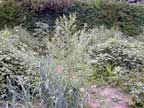
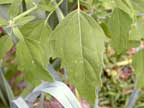
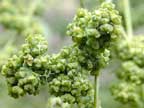
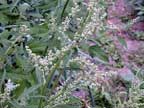
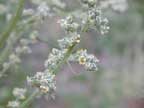
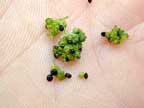
Upright branching plant (1.5m) from a taproot. The leaves are hairless, dull green with toothed margins (especially on the lower leaves) and broader at the base, the stems may be purplish. The flowers are a grey / green colour and are found in dense clusters at the end of the stems and branches. Size and shape of the plant vary enormously depending on the growing conditions.
There are 14 species of Chenopodium in NZ. Most look quite similar, but the other species are less common. Sometimes eaten as a green vegetable by people, normal quantities are not enough to cause problems. Good king Henry (Ch. bonus henricus) is a very similar plant sometimes grown as a vegetable. NZ spinach (Atriplex species.) is similar.
Waste places and cultivated areas such as fields and gardens all over NZ.
Fat hen is a nitrogenous plant with most of the nitrate being found in the roots. However, most cases of fat hen poisoning are probably caused by oxalate. Oxalates are found in the plant as oxalic acid (the free state), or as sodium, potassium or ammonium salts and calcium oxalate.
Most reports involve cattle and sheep.
Hypocalcaemia - listlessness, staggering and deep coma. Death may follow. Aspiration of rumen contents has been reported.
Chronic renal failure - weight loss. If the oxalate crystals are deposited in brain tissue then central nervous system dysfunction may occur. People in Germany after the war ate large quantities of fat hen as the only green vegetable available and some developed jaundice type signs which were attributed to saponins in the roots.
Leaves in rumen, hypocalcaemia.
Other members of the goosefoot family and other poisonous plants containing oxalate eg elephants ear.
Symptomatic care. Calcium borogluconate injections (iv) may be helpful in acute cases.
Avoid grazing new pastures dominated by fat hen (or other weeds such as spurrey).
Connor, HE, The Poisonous plants in New Zealand, 2nd ed.,1977, Government Publications Ltd., Wellington
The Merck Veterinary Manual, edited by Susan E Aiello. Eighth edition published by Merck and Co. Inc, Whitehouse Station, USA, 1998.
Parton K, Bruere A.N. and Chambers J.P. Veterinary Clinical Toxicology, 3rd ed. 2006. Veterinary Continuing Education Publication No. 249
Surveillance, Fat hen poisoning, 33 (1) 12, 2006
Surveillance, Fat hen poisoning, 36 (2) 32, 2009