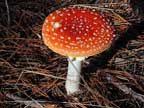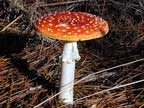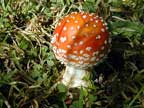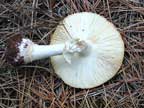
Amanita muscaria
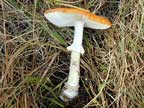
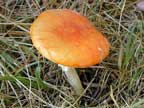
Typical "mushroom" shaped fungus. Cap red or orange with white warty lumps, sometimes rainwashed to yellow or pale brown. Convex, flat or concave. 8 25 cm across. Skin is detachable, flesh is white. Gills white and crowded, not attached to stem. Stem white with bulbous base, ring of warty scales around base. Thin drooping membrane over young gills which appears on mature plants as a skirt near the top of the stem.
There are several other species of Amanita in NZ, all are toxic. There are also several fungi with red caps (no white spots) but none have a skirt around the stem.
Very common under pine trees in both Islands, also found under oak, silver birch, sweet chestnut. Found at the forest perimeters in groups or solitary.
A mixture of two psychotropic isoxazole derivatives makes up the active principle. These are ibotenic acid and its decarboxylation product muscimol. This latter is five times as active as ibotenic acid. Some specimens may contain muscazone. Although present and toxic muscarine has practically no effect on the central nervous system and is not a major toxin. Acetylcholine is also present. Both ibotonic acid and muscimol are excitary amino acids and mimic the effect of glutamate on CNS neurons.
Humans, cattle and goats. One recorded case in a dog and a possible case in a kitten.
Signs occur quickly after ingestion, usually only a few minutes to two to three hours. Excessive lachrymation, salivation and perspiration are characteristic. Severe abdominal pain and copious watery diarrhoea occur consistently, but laboured breathing does not always occur. Respiratory failure preceded by delirium, convulsions and coma will result in death. Both auditory and visual hallucinations occur. Manic behaviour and deep sleep can also be seen.
Liver degeneration, signs of intestinal inflammation, Amanita muscaria may be present in the rumen/stomach.
Clinical signs and history. Post mortem findings may suggest a retrospective diagnosis.
Poisoning by other Amanita species or other psychotropic toxin containing species.
Symptomatic and supportive care. Decontamination may be ineffectual, do not use atropine.
This species rarely poisons fatally, but if death does occur, it does so more rapidly than with Amanita phalloides.
Connor, HE, The Poisonous plants in New Zealand, 2nd ed.,1977, Government Publications Ltd., Wellington
Parton K, Bruere A.N. and Chambers J.P. Veterinary Clinical Toxicology, 3rd ed. 2006. Veterinary Continuing Education Publication No. 249
Surveillance 2005, 32(3), 15