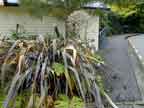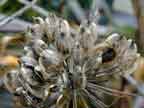
Heracleum mantegazzianum
Do not handle this plant: it causes severe dermatitis in people!
cow parsnip
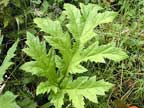
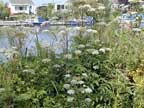
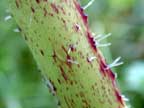
Very large (up to 6m) ridged flower stalks with umbels of white flowers. Leaves c 60cm, deeply divided. Stalks covered with coarse hairs, may have red spots.
Common hogweed, H. sphondylium, is smaller (1.8m) and much less toxic. The huge size of giant hogweed's flower stalk make it unmistakable.
Roadsides and waste places, particularly river banks, from Marlborough to Otago. Grows best in damp places.
Furanocoumarins: bergapten and isopimpinellin ± others in the sap. These cause blistering, particularly in UV light, and are mutagenic.
Mainly people, also goats, sheep and ducks. Horses have been poisoned by common hogweed. Although it causes mouth ulcers in sheep, sheep have been used to control the weed in Denmark.
Dermatitis or blisters in people, mouth ulcers in animals.
Clinical signs and presence of hogweed in pasture.
Symptomatic, topical antibacterials to prevent infection.
Most countries where giant hogweed is a problem have eradication programmes.
Andrews, A. H. Giles, C. J. Thomsett, L. R Suspected poisoning of a goat by giant hogweed. Veterinary Record 1985 116(8), 205-207.
Connor, HE, The Poisonous plants in New Zealand, 2nd ed.,1977, Government Publications Ltd., Wellington
Cooper M R, Johnson A W. Poisonous Plants and Fungi in Britan: Animals and Human Poisoning. Her Majesty’s Stationary Office. London. 1998
Duff, S. McGahie, D Mouth ulcers in horses. Veterinary Record. 2001. 149: 14, 431.
Parton K, Bruere A.N. and Chambers J.P. Veterinary Clinical Toxicology, 3rd ed. 2006. Veterinary Continuing Education Publication No. 249