Galega officinalis
French honeysuckle
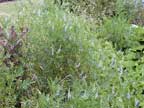
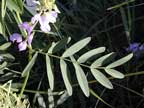
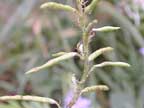
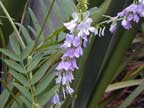
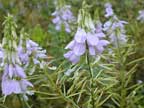
A spreading, many branched shrub that grows up to l.5m. There are four to eight pairs of elliptical, sharp pointed leaflets that are up to 2.5cm in length. The flowers are purple to light blue and occasionally white. The fruit are contained in a pod up to 5cm long.
Several species of vetch look superficially similar.
Common in ditches in the Manawatu, Taranaki and in the shingle in Wellington and Wairarapa. Goat's rue thrives in a warm, humid climate. It can also be found as an ornamental garden shrub.
A toxic amino acid canavanine and six alkaloids the two most common being galegine and peganine. The toxins are still active in the dried plant. The plant is probably most toxic when flowering or fruiting.
Sheep and less commonly cattle (cattle do not seem to like the taste). Some sheep may develop resistance.
Following ingestion of goat's rue, the latent period usually lasts 18 to 24 hours. Then the development of clinical signs is rapid, steadily leading to death within a few hours. The clinical signs always include an impressive dyspnoea. This is associated with severe pulmonary congestion and oedema and a developing hydrothorax. Usually animals are found dead a day or two after being turned on to pasture where goat's rue is abundant and the ground where they lie may be trampled and muddy indicative of a terminal agonal struggle, but this is not seen in most cases.
Foaming nasal discharge, marked congestion of the lungs with pulmonary oedema and hydrothorax. There may be haemorrhagic lesions in the subcutaneous connective tissue and surface haemorrhages of muscles. Goat's rue stalks may be found in the rumen, in most cases.
History and clinical signs.
Organic fluorine poisoning.
No effective treatment.
Poor as animals are usually found dead and if the animal was discovered while dyspneoic the prognosis is still poor as the toxin has already been in the body for 18 - 24 hours.
Do not allowed hungry livestock to graze areas where plants are growing.
Connor, HE, The Poisonous plants in New Zealand, 2nd ed.,1977, Government Publications Ltd., Wellington
Keeler, R.F., Johnson, A.E. and Stuart, L.D. (1986). Toxicosis from possible adaptation to Galega officinalis in sheep and the relationship to Verbesina toxicosis. Vet. Hum. Toxicol. 28:309 311.
Puyt, J.D., Faliv, L., Keek, G., Gedfain, J.C., Pinault, L. and Tainturier, D. (1981): Fatal poisoning of sheep by Galega officinalis (French honeysuckle). Vet Hum Toxicol. 23:410 412.
West, D.M. (1982). A case of plant poisoning of sheep. In Proceeding of the N.Z. Sheep & Beef Cattle Society of the N Z Vet Association, Massey University, Palmerston North. 346 347