Corynocarpus laevigatus
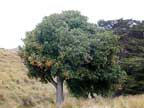
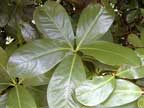
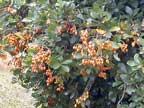
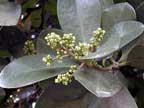
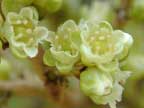
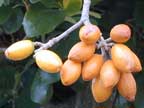
Karaka is a tree up to 15m tall. The leaves are oblong, 10 - 15cm long, dark green, thick and glossy. The small flowers are yellow green in colour. Orange fruit, 25 - 40mm long of three layers (i.e. outer skin, fleshy layer and hard inner layer enclosing the seed.)
Several trees have similar leaves but the orange fruit is distinctive.
Native to New Zealand. Karaka is found in the lowlands, especially coasts. It is abundant in the North Island and is found in areas such as Nelson, Marlborough and Banks Peninsula in the South Island.
The toxin is karakin, a glucose ester of 3 nitropropionic acid. 3NPA irreversibly blocks succinate dehydrogenase and thus blocks Kreb's cycle so interfering with ATP synthesis. The superoxide radicals released cause oxidative stress and damage mitochondria. The end result resembles hypoxic brain damage.
The fresh fruit is the toxic part, although dogs have been poisoned by chewing seedlings. The toxin decreases somewhat as the fruit ages. The fruits of the karaka tree were formerly used by the Maori but were baked for a very long time and washed before use. The nectar is also toxic which is important for bees.
3NPA poisoning in rodents is used as a model of Huntingdon's chorea, so the molecular effects have been well studied.
The toxin has effects on man and dogs but may have a lesser effect on cattle and sheep (broken down by rumen micro-organisms) and pigs. Most clinical cases of poisoning are in dogs.
Convulsions and spasms may precede paralysis of the hind limbs and muscle incoordination. Death may occur.
History, clinical signs, leaves/kernels in rumen/stomach.
Gastric lavage. Symptomatic and supportive treatment for poisoned animals. Some promising research suggests that antioxidants that scavenge free radicals are neuroprotective for 3 NPA. NMDA antagonists may reverse the toxic effects of 3 NPA but must be administered soon after ingestion.
The prognosis depends on the severity of poisoning. Less severely affected animals may recover with no apparent residual effects.
Do not allow animals to eat fallen fruit.
Connor, HE, The Poisonous plants in New Zealand, 2nd ed.,1977, Government Publications Ltd., Wellington
Gregory, N.G. Orbell, G.M.B. and Harding, D.R.K. (2000). Poisoning with 3 nitropropionic acid in possums (Trichosurus vulpecula). N Z vet J. 48:85 87.
Parton K, Bruere A.N. and Chambers J.P. Veterinary Clinical Toxicology, 3rd ed. 2006. Veterinary Continuing Education Publication No. 249
Surveillance 2005, 32(3) , 14