Nerium oleander
rose bay
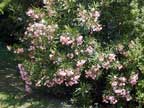
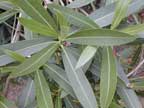
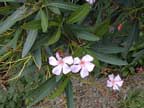
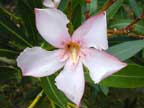
Ornamental woody, flowering evergreen shrub to 4m high. Dark green leaves are opposite in pairs or in whorls of 3 or 4, about 20 cm long, narrow and lance shaped, leathery with prominent midrib (can be variegated). Flowers red, pink or white up to 8cm diameter, funnel shaped and sometimes strongly scented. Fruit is cylindrical and up to 15 cm long.
Leaves and shape of the bush are similar to the rhododendron. A number of related species. are present in NZ but are not thought to be poisonous.
Popular garden plant in North Island and south to Canterbury. Naturalised in Northland.
Cardiac glycosides, mainly oleandrin (oleandroside) and neriine (nerioside), similar to digitalis. They act to delay the conduction through the AV node and to potentiate vagal activity. Ingestion of even small amounts of these toxins can be fatal. The entire plant is toxic, and consuming dried or fresh leaves is poisonous. The smoke of burning oleander is believed to be toxic. The lethal dose of oleander leaves for cattle and horses is 0.005% of the animal's body weight. The minimum lethal dose for cattle is 50 mg/kg. Horses developed clinical signs (gastroenteritis and cardiac toxicity) when given 40 mg/kg of green leaves. Six leaves are supposed to be enough to kill a horse. Cardiac glycosides inhibit the cellular membrane sodium potassium pump that depletes intracellular potassium and increases serum potassium. Decreased electrical activity results causing irregular heart beats leading to complete heart block and death. Hyperkalaemia is usually a feature of oleander toxicity.
Humans and all classes of livestock. In one case 6 of 40 Friesian heifers were found dead.
GI irritation, anorexia, vomiting, bloodstained faeces, colic, irregular heart action, excitement, pyrexia, ventricular fibrillation, salivation, mydriasis, frequent defecation, uneasiness, urination, profuse sweating and convulsions and paralysis preceding death. As the signs progress, the extremities may become cold and the mucous membranes pale. Death may be preceded by malaise, drowsiness and paresis. Oleander can cause dermatitis in people.
Gastroenteritis with petechial haemorrhages and engorgement of the lungs and visceral organs. The heart may be grossly distended (especially the auricles) and have necrotic patches.
History and clinical signs (arrhythmias). Oleandrin, or another glycoside, may be converted to digoxin in the body and RIA for digoxin can be positive. Oleandrin has been detected in gastric contents using thin layer chromatography.
Foxglove, milkweed and lily of the valley poisoning. These contain digitalis glycosides and have a similar action in animals. Digoxin overdose.
Symptomatic treatment as for cardiac glycoside toxicity. Antiarrhythmic drugs are indicated in ventricular tachyarrhythmias. Lignocaine (short acting) or other class 1 antiarrhythmics should be given. Atropine can be used to treat both sinus bradycardia and 2nd or 3rd degree heart blocks. Depending on time of ingestion gut decontamination with gastric lavage and activated charcoal (2-5 grams/kg) may be indicated. In general, mild purgatives followed by demulcents are recommended. Symptomatic treatment including IV fluids if required.
Some cases will recover spontaneously, but treatment is usually helpful.
Ensure animals do not have access to the plant or clippings.
Adam, SEI; Al Yahya, MA; Al Farhan, AH Toxicity of Nerium oleander and Rhazya stricta in Najdi sheep: hematologic and clinicopathologic alterations. American Journal of Chinese Medicine 30 (2/3): 255-262 2002
Conner H.E. The Poisonous Plants In New Zealand. 1992. GP Publications Ltd, Wellington
Cooper M R, Johnson A W. Poisonous Plants and Fungi in Britan: Animals and Human Poisoning. Her Majesty’s Stationary Office. London. 1998
Parton K, Bruere A.N. and Chambers J.P. Veterinary Clinical Toxicology, 2nd ed. 2001. Veterinary Continuing Education Publication No. 208
Surveillance (2006) 33(3):9 Oleander poisoning in a horse
Hughes KJ, Dart AJ, Hodgson DR Suspected Nerium oleander (Oleander) poisoning in a horse. Australian Veterinary Journal, 80 (7): 412-415
Surveillance 31(1) 2004
Surveillance 35(3) 18-19 2008 Oleander poisoning in alpacas
Renier AC, Kass PH, Magdesian KG, Madigan JE, Aleman M, Pusterla N. Oleander toxicosis in equids: 30 cases (1995-2010). J Am Vet Med Assoc. 2013 Feb 15;242(4):540-9. link