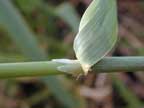
Phalaris tuberosa, Phalaris aquatica and Phalaris arundinacea
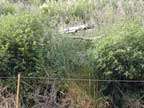
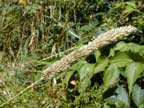
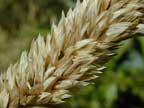
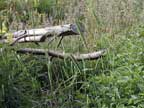
Grasses which grow from 1 (P. tuberosa) to 2 metres (P. arundinacea) in height. P. tuberosa has long, tapering and smooth leaves except for the margins.The flowers are dense, cylindrical and in spikelike panicles about 3 cm in length. P. arundinacea have long, finely pointed, rough leaves up to 30 cm in length. The flowers are dense, spikelets in narrow panicles up to 35 cm long.
Other coarse grasses such as cocksfoot and tall fescue have similar leaves, but can be told apart from their flower heads.
Widely distributed as pasture species or on roadsides in both islands.
Both plants contain the indole alkaloid N,N dimethyltryptamine and its 5 hydroxy (bufotenine) and 5 methoxy derivatives which are structurally similar to serotonin. These act as inhibitors of monoamine oxidase and interfere with serotonin and catecholamine action, metabolism and detoxication. 5 methoxy dimethyltryptamine appears to have a direct action upon serotonergic receptors in specific brain and spinal cord nuclei. The alkaloids vary in toxicity and their concentration in the grass is affected by environmental conditions. Toxicity may result from ingestion of a relatively small amount of grass with high alkaloid content or a large amount with a low alkaloid content. Phalaris species when subjected to dull cloudy weather for some time are likely to be toxic to sheep. If the light intensity is high, they are unlikely to be dangerous unless soil nitrate levels are also high (as a result of several years clover growth). The danger of toxicity increases when day temperatures are 20 C or above, particularly when light intensities are low i.e. the autumn period is a favourable time for phalaris poisoning to occur.
Earlier work suggesting that phalaris poisoning was likely to occur in sheep with a low cobalt status has not been substantiated.
Sheep.
Seen within 12 - 72 hours of hungry animals going on to toxic pasture. Animals will suddenly collapse, especially when excited or moved. They will show arrhythmic tachycardia and ventricular fibrillation, and death may occur at this stage. Some animals will lie on their sides, and show convulsive spasms, dorsiflexion of the head and neck, jaw champing with ropy saliva, rigid extension of the limbs and severe tachycardia. Some less severely affected sheep may be hyperexcitable and ataxic, with nodding of the head, twitching ears and tail, chewing and salivation. All these signs are easily triggered by excitement and individuals which try to run will inevitably fall down.
Similar neurological signs to those described above, but they persist when the animals are moved from the phalaris. Many of these sheep have persistent, uncontrollable head nodding, limb weakness and arrhythmic tachycardia. These signs may last in sheep for months. The morbidity rate is high in most outbreaks and there may be up to a 50% mortality on occasions.
Acute congestive heart failure (congestion of the abdominal viscera and petechial haemorrhages of the epicardium). There may also be blood stained nasal discharges.
Evidence of plant ingestion and clinical signs. A definitive diagnosis may be made from the histological examination of formalin fixed brain tissue.
None.
If Phalaris is to be grazed, then sheep should be introduced to the pasture over a period of several days, then set stocked with high stocking rates during periods of lush growth. The risk of toxicity is increased by grazing autumn saved phalaris pasture, spelling and rotational grazing.
Hungry sheep should never be turned on to phalaris pasture. Hay made from the pasture is much less toxic than the original pasture, because the alkaloids break down as the plants dry.
Bourke, C.A. Carrigan, M.J. and Dixon R.J. (1990). The pathogenesis of the nervous syndrome of Phalaris aquatica toxicity in sheep. Aust Vet J. 67(10):356 358.
Conner H.E. The Poisonous Plants In New Zealand. 1992. GP Publications Ltd, Wellington
Milne, J.A. (1955). The Occurrence of Phalaris staggers in sheep. N Z vet J. 3:119 121.
Parton K, Bruere A.N. and Chambers J.P. Veterinary Clinical Toxicology, 2nd ed. 2001. Veterinary Continuing Education Publication No. 208
Simpson, B.H., Jolly, R.D. and Thomas, S.H.M. (1969). Phalaris arundinacea as a cause of deaths and incoordination in sheep. N Z vet J. 17:240 244.
Surveillance (1976) 3(5): 23 Ewe deaths associated with Phalaris tuberosa.
Surveillance (1982) 9(2): 29 Pasture plant poisoning.
Surveillance (1991) 18(4):35 Phalaris staggers in Romney ewes.
Surveillance (1994) 21(3):31 Phalaris tuberosa staggers in sheep.
Surveillance (1995) 22(1): 3 Phalaris neurotoxicity of cattle.
Surveillance (1998) 23(4):14 Phalaris toxicosis in Romney lambs.
4 October, 2007