Ligustrum species
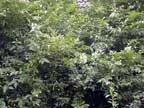
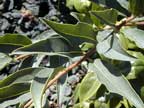
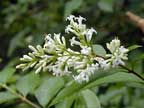
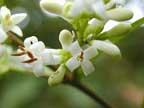
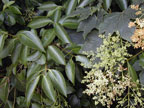
Evergreen shrub up to 5m. Oval shaped dark green leaves (some cultivars variegated with yellow edges). Small white flowers in a panicle. Fruit a black berry c 6mm dia but not often produced.
There are 4 naturalised species in NZ. L. ovalifolium (pictured)
is probably most common.
L. lucidum, the tree privet, and L. sinense, the Chinese
privet, are locally common around Auckland; L. vulgare, the "common"
privet, is naturalised in parts of the S. Island.
An escape from cultivation where it is traditionally grown for hedges because it clips well.
Ligustrin, a glycoside. Berries are thought to be most toxic, but the leaves have caused problems too, usually as hedge clippings thrown into a paddock. The pollen is popularly supposed to cause hay fever or asthma in people, but this seems unlikely as the bushes are pollinated by insects rather than broadcasting pollen.
Cattle, sheep, horses and children.
Horses: colic and unsteady gait / hind leg paralysis, rapid pulse, congested mucous membranes, dilated pupils, followed by death 4 - 48 hours later. Sheep and cattle have been found dead. Children vomiting, diarrhoea ± dermatitis.
Nonspecific intense gastroenteritis.
History, clinical signs, plant material in the stomach/rumen.
Symptomatic.
Poisoning is rare but often fatal.
Take care with disposal of hedge clippings.
Anonymous, Accidental poisonings of stock. NZ Journal of Agriculture, 1939, 59, 429 431
Conner H.E. The Poisonous Plants In New Zealand. 1992. GP Publications Ltd, Wellington
Cooper M R, Johnson A W. Poisonous Plants and Fungi in Britan: Animals and Human Poisoning. Her Majesty’s Stationary Office. London. 1998
Parton K, Bruere A.N. and Chambers J.P. Veterinary Clinical Toxicology, 2nd ed. 2001. Veterinary Continuing Education Publication No. 208
4 October, 2007