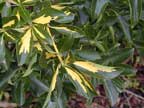
Euonymus europeus
spindleberry
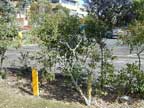
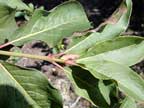
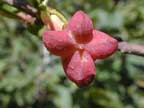
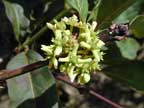
Deciduous shrub or small tree 2-6 m high. The bark is grey and smooth. Leaves are oval leathery dark green turning yellow or red in the autumn. It has small greenish white flowers and four lobed fruit which turn from green to red in the autumn.
Japanese spindle trees (E. japonicus) are common in gardens. Probably poisonous.
Found throughout NZ. An ornamental which occasionally escapes onto waste land, bush margins and plantations.
Not certain. Contains cardiac glycosides in fruits and leaves evonoside, evogioside and evomonoside the aglycone is digitoxigenin. Also 12 alkaloids found at a concentration of 0.1% in seeds: the major one is evonine. All parts of plant toxic.
Reported poisonings are rare. Seen in mainly in people but also animals. Reported cases include toxicity in goats and horses. Fatal poisoning’s of 2 horses which ate shoots.
Can have a long latent period. Man - nausea, vomiting, diarrhoea, weakness, chills, coma and convulsions. Animals are said to look purged. Horses have reported to become restless and suffer paralysis of the digestive tract with consequent constipation. Their pulse also became rapid and death occurred within 4 days.
Inflammation of the intestine of horses.
Exposure to plant and clinical signs.
Colic, grass fever in horses. Clinical signs not well established.
Gastric lavage and activated charcoal. Purgatives and demulcents.
Guarded. Can be fatal.
Conner H.E. The Poisonous Plants In New Zealand. 1992. GP Publications Ltd, Wellington
Cooper M R, Johnson A W. Poisonous Plants and Fungi in Britan: Animals and Human Poisoning. Her Majesty’s Stationary Office. London. 1998
Parton K, Bruere A.N. and Chambers J.P. Veterinary Clinical Toxicology, 2nd ed. 2001. Veterinary Continuing Education Publication No. 208
4 October, 2007