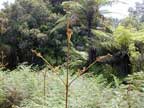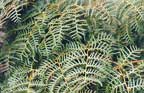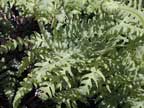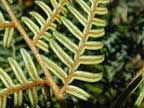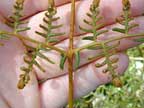
Pteridium esculentum
bracken fern, rarauhe
Perennial herb which spreads by stout, black horizontal rootstocks often more than a metre long. The fronds are large and broadly triangular being hairy on the underside. Orange stems.
Water fern is similar but has soft green foliage and stalks. Toxicity unknown. The British bracken, P. aquilinum, does not occur here, but it is almost identical and much of the data on bracken poisoning comes from this species.
Widely distributed in upland and marginal areas thoughout NZ.
Bracken fronds and rhizomes contain the enzyme thiaminase: monogastric animals (horse and pig) which do not synthesis their own source of thiamine become deficient in thiamine after a few weeks of ingestion of the plant. In addition, various thermostable compounds that destroy thiamine also exist in bracken and these increase the effect of the thiaminase. The roots or rhizomes of bracken contain substantially more thiaminase than the fronds.
Bracken contains ptaquiloside, an "aplastic anaemia factor" and carcinogen, which affects the haemopoietic tissue of the bone marrow and causes a reduced production of thrombocytes, leucocytes and erythrocytes. As a result leucopaenia, thrombocytopaenia, increased capillary fragility and prolonged bleeding time develop (haemhorraghic syndrome). In the latter stages of the disease, there is defective clot formation and a fall in erythrocyte count and haemoglobin levels.
Enzootic haematuria in cattle (BEH) and to a lesser extent sheep, has been associated with the eating of bracken. Ptaquiloside causes this condition in addition to its affects on red blood cells. Ptaquiloside has also been shown to cause an acute bracken toxicity in cattle. It would appear there are seasonal and possibly locational differences in concentration of the carcinogen in bracken, which confirms the well recorded differences between areas and the rather local occurrence of bovine enzootic haematuria.
Bracken is dangerous only in the stage of active growth (brown and withered fronds are harmless). Both leaves and rhizomes contain the toxic principles. Young bracken is also known to contain harmless amounts of hydrocyanic acid and tannic acid. The toxic effects are cumulative and may require one to three months to develop. Acute poisonings are usually seen in periods of drought when grazing is scarce.
Primarily horses and cattle, disease in pigs is rare. Thiamine deficiency has also been reported in goats.
There are 5 main syndromes caused by bracken:
In NZ the haemorrhagic disease and the neoplasia of the urinary bladder of ruminants have been reported but the thiamine deficiency of monogastric livestock probably occurs as well.
Horses: signs typical of thiamine deficiency. Incoordination leading to pronounced staggering. The horse stands with its feet wide apart and back arched. In severe cases agonal tachycardia is present. Severe muscular tremors appear. Recumbency occurs with death being preceded by clonic spasms and opisthotonus. The rectal temperature may rise but is usually normal.
Cattle: Signs may be delayed for up to two eight weeks after access to bracken has been stopped. Two forms are seen one in adult and one in young cattle. In adults, depression, anorexia, enteritis with blood clots in the faeces are seen. Petechial haemorrhages can be seen on mucous membranes with bleeding from the nostrils, intestinal and urogenital tracts. Prior to death the body temperture is markedly raised.
Calves: Animals appear dull and listless with a mucus discharge around the nostrils and mouth and pyrexia. Oedema of the throat region occurs leading to a difficulty in breathing.
Lesions are not characteristic but are consistent with death from heart failure. Cattle have extensive haemorrhages throughout the tissues of the body (especially the bladder), with numerous ulcers in the digestive tract. There may be high incidence of primary bladder tumours e.g. papilloma, squamous cell carcinoma, leiomyosarcoma, haemangioma in cattle and sheep grazing bracken.
Horses: Decreased blood thiamine levels or an increase in blood pyruvate with a decrease in RBC transketolase activity.
Cattle: Clinical signs are distinctive with history of possible ingestion. Haematologic examination shows a loss of platelets accompanied by a loss of WBCs and pancytopaenia in advanced stages.
Horses: ragwort poisoning. Thiamine deficiency in horses can also be caused by horsetail (Equisetum arvense) and turnip.
Cattle: Any acute septicemia (e.g. anthrax), mycotoxicosis and sweet clover poisoning.
Horses: Injection of a thiamine solution at 5 mg/kg body weight and removal from the contaminated pasture (disease may appear once the animal has been moved).
Cattle: Removal from contaminated pasture. Treatment with d 1 batyl alcohol to stimulate bone marrow is of doubtful value. Blood transfusions may be lifesaving. Prevention is the key.
Good if diagnosis is made early. In acutely affected cattle mortality is usually about 90% with the platelet count being the best prognostic indicator.
Bracken has good nutritive value, equivalent to good quality meadow hay and in many areas its grazing is economically important. There are no practical methods for control because of the extensive rhizome system characteristic of the plant. Heavy trampling by cattle and over sowing with grasses has been used on much NZ hill country, but this method is not now much used. Careful feeding may be desirable and is possible. Animals should be put onto bracken free pasture for one to three weeks at a time, following a similar grazing period on bracken. If cattle are used to trample bracken, then adequate hay must be available in the grazing area. It is unadvisable to cut hay which contains large quantities of bracken.
Connor, HE, The Poisonous plants in New Zealand, 2nd ed.,1977, Government Publications Ltd., Wellington
Parton, K, Bruere AN, Chambers JP. (2006). Veterinary Clinical Toxicology. 3rd ed. Veterinary Continuing Education No. 249.
Clarke, M.L., Harvey, D.G. and Humphreys, D.J. (1981). Veterinary Toxicology 2nd Ed.Bailliere Tindall, London. 214 217.
Cunningham, I.J. (1952). Bracken fern poisoning. N Z vet J. 1:36 37.
Evans, W.C. (1976). Bracken Thiaminase mediated neurotoxic syndromes. Bot.J.Linn.Soc. 73:113 131.
Evans, W.C., Patel, M.K. and Koohy, Y. (1982). Acute bracken poisoning in monogastric and ruminant animals. Proc.R.Soc.Edinb. 81B:29 64.
Perez-Alenza MD, Blanco J, Sardon D, Sanchez Moreiro MA, Rodriguez-Bertos A., Clinico-pathological findings in cattle exposed to chronic bracken fern toxicity, New Zealand Veterinary Journal 54(4), 185-192, 2006
Rasmussen LH, Lauren DR, Smith BL, Hansen HCB. Variation in ptaquiloside content In bracken ( Pteridium esculentum (Forst. f) Cockayne ) in New Zealand, New Zealand Veterinary Journal 56(6), 304-309, 2008
Shahin M. Smith BL. Prakash AS. Bracken carcinogens in the human diet. Mutation Research. 443(1-2):69-79, 1999
Smith, B. L. (1990) Bracken fern and animal health in Australia and New Zealand. Aias Occasional Publication. 40: 227 232.
Smith, B.L., Embling, P.P., Agnew, M.P., Lauren, D.R. and Holland, P.T. (1988). Carcinogenicity of bracken fern (Pteridium esculentum) in New Zealand. N Z vet J. 36:56 58.
Smith, B.L. and van der Wouden, M. (1972). Bovine enzootic haematuria lesions in cattle passing through a Nelson meatworks. N Z vet J. 20:56.
Sunderman, F.M. (1987). Bracken poisoning in sheep. Aust vet J. 64:25 - 26.
Surveillance (1975) 2(1):24 Bracken fern poisoning (calves)
Surveillance (1975) 2(3):18 Bracken fern poisoning (yearlings)
Surveillance (1977) 4(1):18 Bracken fern poisoning (cattle)
Surveillance (1977) 4(3):21 Bracken fern poisoning (cattle)
Surveillance (1978) 5(4):21 Bracken fern poisoning (laryngeal form calves)
Surveillance (1983) 10(3):15 Bracken fern poisoning (cattle)
Surveillance (1990) 17(1): 3 Bracken fern poisoning (cattle)
Surveillance (1990) 17(3): 3 Bracken fern poisoning (cattle)
Surveillance (1992) 19(4): 3 Bracken fern poisoning (cattle)
Surveillance (1994) 21(3):31 Bracken fern poisoning (cattle)