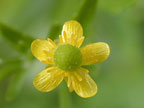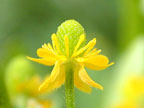
Ranunculus sceleratus
Poison buttercup
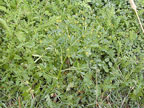
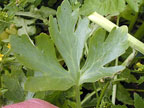
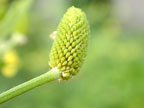
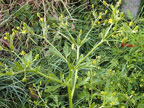
An annual plant with fibrous roots. The stems are hollow, stout and erect, more or less glabrous or with sparse appressed hairs up to 80 cm tall. The basal leaves have long stalks, 3 lobed and lobes often 2 - 3 sublobes; upper leaves on shorter stalks and divided into 3 segments. Many flowers 6 - 10 mm diameter on glabrous, furrowed stalks. Sepals are turned down and as long as petals. Fruit are conical.
Other members of the buttercup family.
Damp swampy areas and waterways or poorty drained paddocks. Widely distributed throughout New Zealand.
Ranunculin and 5 hydroxytryptamine and other tryptamine derivatives have been found in this species. Ranunculin is a glycoside that forms the irritant protoanemonin which is unstable and polymerises to crystalline nontoxic anemonin. Toxicity is low as protoanemonin is irritant and deters most animals from ingesting sufficient amounts. Protoanemonin causes erythema and blistering of the skin. All parts of fresh plants are poisonous. Toxin levels are the highest in spring.
All livestock are susceptible. Reports of poisoning in cattle, sheep and goats. Animals tend not to eat them but when abundant as in areas like Westland, Northland and other western districts they are invariably consumed by cattle in particular.
Signs include excessive salivation, mouth soreness, ulcers and abdominal pain . Severe cases have a diarrhoea black in colour and bloodstained urine, weakness, staggering, impaired hearing and vision. Death is preceded by severe convulsions after 12 hours.
Acute inflammation of the stomach and intestines. Mouth and throat lesions. Rumen contents may contain a large amount of buttercup. Renal damage is sometimes evident.
Presence of buttercup in the ingesta. Presence of severe gasteroenteritis. Exclusion of other causes. Diagnosis is difficult as an amount of buttercup is found in almost all ingesta.
Other plant poisonings especially those containing ranunculin, eg Old Mans Beard and other species of Clematis, or those containing protoanemonin, eg Anemone species. Malignant Catarrhal Fever.
Mild purgatives, demulcents. Potassium permanganate protects the skin from irritant action of protoanemonin.
Usually good, especially in mild cases.
Use chemical or other control methods to remove buttercups or avoid overstocking pastures with livestock when large quantities of buttercup are present.
Connor, HE, The Poisonous plants in New Zealand, 2nd ed.,1977, Government Publications Ltd., Wellington