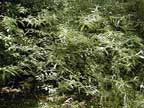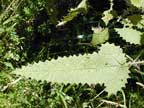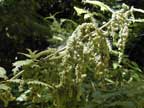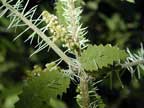
Urtica ferox
ongaonga
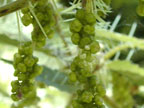
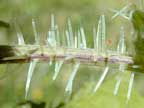
Grows up to 2m tall as a perennial straggly bush. The plants are much branched and have stinging hairs up to 6mm long covering the stalks and margins of the leaves. Flowers are small and green.
Other nettles. The annual nettle is much smaller and not woody. The perennial nettle usually grows as a single stem. It forms dense spreading colonies from very tough rhizomes.
Tree nettles are abundant throughout NZ, in bush and in open country, particularly on waste and neglected land. The tree nettle is common on the fringes and within bush as far south as Otago.
Histamine, serotonin and acetylcholine are present as well as other pain producing agents that have been isolated but whose identity is not clear. Poisonous parts: fine white stinging hairs. The tree nettle is the most dangerous. Other species cause an intense short-lived irritation.
All animals , particularly dogs, horses, sheep and humans.
Dogs develop trembling, vomiting, difficulty breathing and general pain. Convulsions and death may follow in severe cases. A temporary loss of scenting ability has been reported in the dog. Horses may become excitable and restless. Lesions can be seen in sheep on the udder and hairless parts. In humans there are reports of fatal poisoning with nettles both in NZ and overseas. Initially in people there is a pricking sensation, rapidly followed by reddening and soreness of the skin, which passes away after a few hours. In severe and fatal cases, stomach cramp, difficulty in breathing and exhaustion have been reported. In cases that survive there may be muscle soreness for a period of days afterwards.
Wheals may be observed on the skin.
Based on observation of wheals and a history of possible contact.
Insect bites or stings, food allergies, toxic chemicals such as turpentine, carbolic acid, carbon disulfide or crude oil. Also medications that cause an allergic reaction.
Rapid acting topical adrenocorticosteroids, such as hydrocortisone or prednisolone will control itching. Antihistamines are of questionable value and may induce urticaria if given rapidly iv. Usually local treatment of the lesions are not necessary, however in especially severe cases, cold packs of water, vinegar or alcohol (70%) may be applied.
Wheals usually disappear spontaneously, scratching or rubbing may induce secondary bacterial infections.
Conner H.E. The Poisonous Plants In New Zealand. 1992. GP Publications Ltd, Wellington